
NHK Media Technology, Inc. (Japan) [ report provided by Monthly NEW MEDIA ]
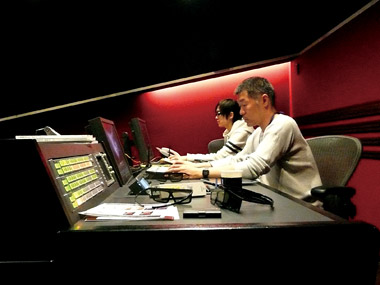
Final process was done at NHK-MT original editing studio "Blaze"
Editing console at an editing studio named "Blaze"
The 3D footage has been edited at a high-definition 3D studio named "Blaze" designed by NHK-MT. One key feature of this studio is the ability to work on 3D editing with a large 150-inch screen. Deputy General Manager Itaru Murayama said that "when we were capturing the footage in the field, we rarely had time to set up, and we faced some really severe conditions. However, we focused on delivering the reality of the scene and tried to draw our audience into it." Then we asked him to explain some major points of making high-definition 3D documentaries.
The 3D crew consisted of three members: a director, a cameraman, and a stereographer, which is a special role for shooting in 3D. The 3D footage was usually shot with two cameras that recorded both the left and right eye images in separate recorders. This required a special rig on which the cameras were mounted, making the equipment unwieldy. Since maneuverability was a key to vividly capture the reality of the disaster areas, the team decided to use Panasonic's AG-3DA1, which is the world's first integrated twin-lens 3D camera recorder. At first glance, it looks like a compact high-definition camera recorder.
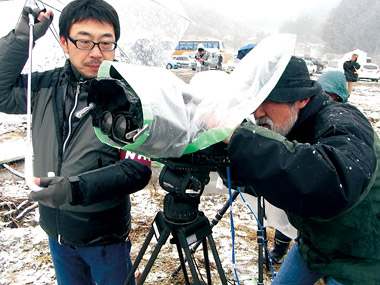
The acquisition was done like an taking place game between the cameraman and the stereographer
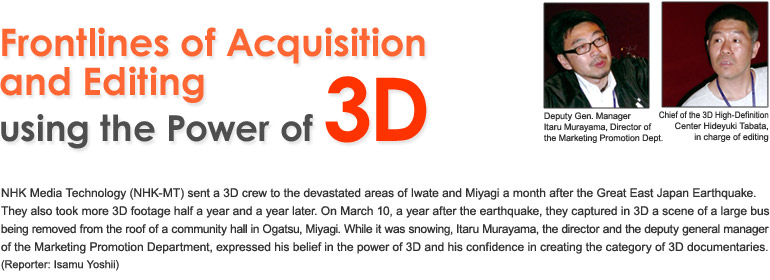
Chief Engineer Akira Saito, a stereographer and an expert of 3D acquisition, said "this integrated twin-lens camera really provided maneuverability during acquisition." Hideyuki Tabata, the chief of the 3D High-Definition Center and in charge of editing, claimed that "the amount of footage taken in such a short period of time shows this camera's portability."
Acquisition in 3D requires excellent teamwork between the cameraman and the stereographer. Director Murayama said, "A stereoscopic vision is recreated with two pieces of video footage using the parallax of the left and right eyes, so controlling the parallax by the angle of convergence is crucial. This created tension between the cameraman who wants to shoot his angle and the stereographer who wants to control the 3D effects. It's like an encampment game." During acquisition they constantly exchanged such questions or comments as "OK now?" or "Pull back a bit." "Even with an integrated 3D camera recorder, a good 3D image can be shot not only by a cameraman but also using a stereographer's 3D design," explained Murayama.
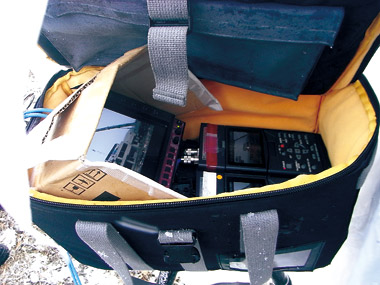
Integrated twin-lens 3D camera
The two objects on the right are recorders to capture the left- and right-eye images, while the object on the left is a monitor for checking the 3D effect. It is small enough to fit into a backpack, giving portability.
Ensuring natural vision movement so that audiences can comfortably watch 3D
Chief Tabata relied on his almost two decades of 3D experience while editing 3D at the Blaze studio. "I'm planning 3D footage that people can watch from the beginning to the end without any discomfort that also has a natural vision flow. The key point is the different usage or know-how of fade-in, fade-out, overlap, or captions from 2D image creation."
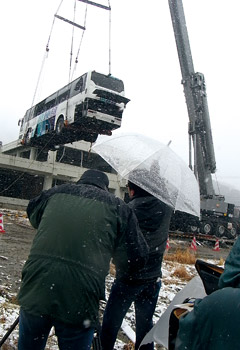
"Editing so that a montage leaps out at you and shows the depth effect of the 3D footage is important," said Director Murayama. The falling snow in the scene where the bus was being removed from the roof actually added to the sense of depth in the footage, because its motion acted as a delicate layer between the objects in the foreground and the background.
Fixed-point observation 3D recording has increased its value as time passes
Shooting the removal of a bus from the roof of a building in 3D
Why does NHK-MT record the disaster areas in 3D? CEO Hirokazu Nishiyama explains. "We were considering what we could do for the disaster areas, and we decided to record them using the 3D technology that we've accumulated over the last quarter century. We hope the sense of depth that is missing in 2D will lead to new discoveries and contribute to future disaster prevention and disaster minimization."
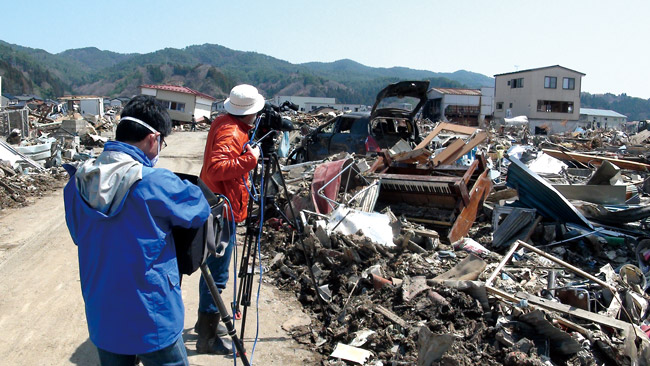
Many areas affected by the disaster have been recorded at fixed points of observation, including Taro in Miyako City and Rikuzentakata City in Iwate and Kesennuma City, Minami-Sanriku, and Ookawa Elementary School in Ishinomaki City, Nobiru in Higashi-matsushima City, and Wakabayashi in Sendai City in Miyagi. The value of fixed-point observation footage will inevitably increase as time passes. The amount of information in 3D also deserves attention. Although the camera was small, one lens recorded in full high-definition quality 1920x1080 resolution, and the twin lens doubled the amount of captured data.
Chief Engineer Takao Ito at the Tohoku office in charge of the acquisition said that "3D footage allows you to see the thickness of the air." Murayama added: "After viewing the 3D footage, some people said the sense of 'being there' is even more vivid than actually being at the place. The hidden potential of 3D film is full of surprises."
A 16-minute documentary called the "Aftermath of the Tohoku Earthquake" was created and screened at the Disaster Reduction and Human Renovation Institution 3D theater from last summer to this March. A sequel including footage showing the disaster areas a year later will be completed in late April.
Kesennuma one month after the disaster (photo provided by NHK-MT)
* The Users Reports provided above is correct as of the time of publication. Note that information such as company and organization names may no longer be correct.